






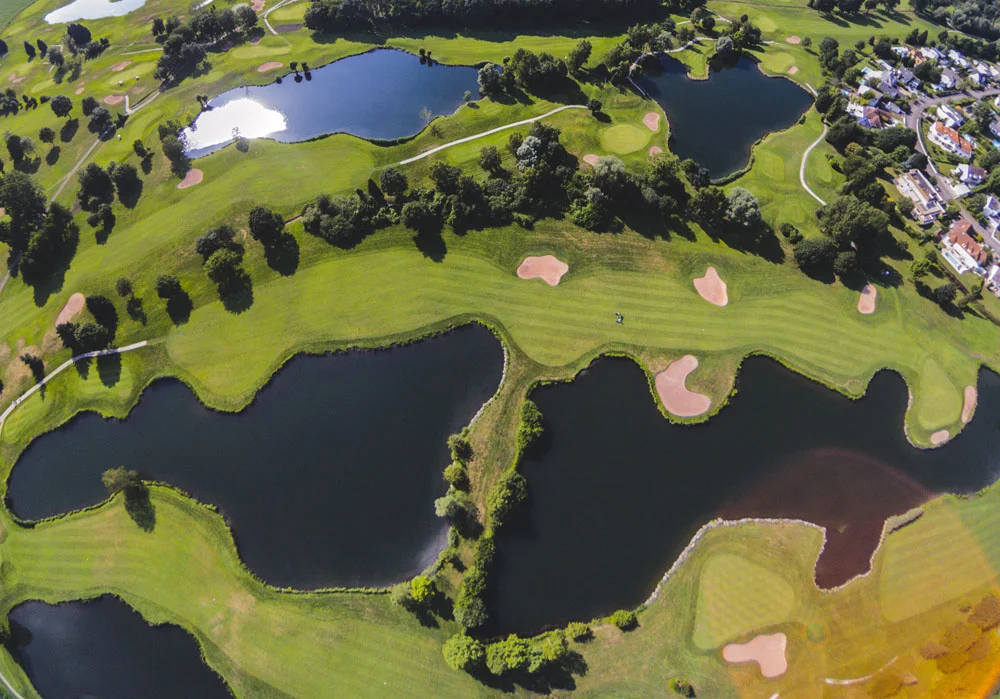

Proper drainage on a golf course ensures maximum usage of the course while maintaining healthy and attractive grass. Whether due to excess rain or imbalanced irrigation, golf course soils frequently become saturated. Saturation leads to unhealthy turf due to disease and/or compaction.
Frequently, especially in arid regions, it is advantageous to collect excess water for use in ponds or irrigation rather than to allow it to flow away. Multi-Flow is a superior drainage system with the ability to accomplish what other systems cannot. It is very efficient at collecting excess water from saturated areas.
A few samples of Multi-Flow golf course drainage can be found in our Sample Projects file. Advice on golf course drainage design is located in the Drainage Design section of Engineering, while sample drawings can be found under Details and Plans. Detailed installation assistance is provided in the Golf Course section of Installation.
Because Multi-Flow is typically installed in a 4 inch wide trench, it is conveniently installed vertically wherever trenching is required. In new construction but even more importantly in remedial settings, the amount of spoil that needs to be hauled away and the amount of backfill that needs to be carried back in are important factors in determining time and cost. Furthermore, in remedial settings, the reduced scarring is also an attractive benefit of Multi-Flow.
Single trunk lines running the length of a fairway or just through low areas can provide effective drainage. Spurs off the left or right or both into low-lying areas adds effectiveness.
When a cart path acts as a barrier to normal water movement from a higher to lower area, a Multi-Flow line acts as an escape route for water. In low lying areas, Multi-Flow collector lines on both sides of the path can prevent the saturation and deterioration of the path base.
Trenching Multi-Flow into the bunker base places it out of reach of maintenance equipment. An intensive pattern provides even and prompt drainage without encouraging the migration of bunker sand during heavy rain events.
Single vertical runs of Multi-Flow are often the best solution to soggy areas in tees, roughs, flower beds, and transition areas.
In settings where all of the soil has been temporarily removed, exposing a clay base, no trenching is needed. Multi-Flow can simply be rolled out and installed horizontally. Recent research by Dr. Ed McCoy at Ohio State University has demonstrated that this trenchless system provides drainage effectiveness similar to trenched systems without the extra time and expense involved.
Greens are most effectively drained with an intensive pattern. This produces two desired effects: excess water is removed quickly and minimal migration of soil particles occurs. When drain lines are distributed throughout the green, water simply moves straight down. Water that moves gently and a minimal distance is less likely to dislodge soil particles. This exposes the drainage system to less danger of blockage.
A similar pattern is sometimes utilized in bunkers if the bunker has a wide flat bottom. Frequently bunkers require substantial drainage capacity because surrounding greens or fairways slope toward them.
Whether it is new course construction or the renovation of an existing course, Multi-Flow is a wise choice because Multi-Flow is 1) easy to use 2) long lasting 3) highly efficient 4) cost effective.
Multi-Flow and Multi-Flow LDVS are property of Varicore Technologies, Inc.
The information contained on this site, including technical drawings, illustrations, pictures, diagrams, etc., are for recommendation only.
It is sole responsibility of determine correct suitability and usage of materials on project.