
Golf Courses
Vertical Installation
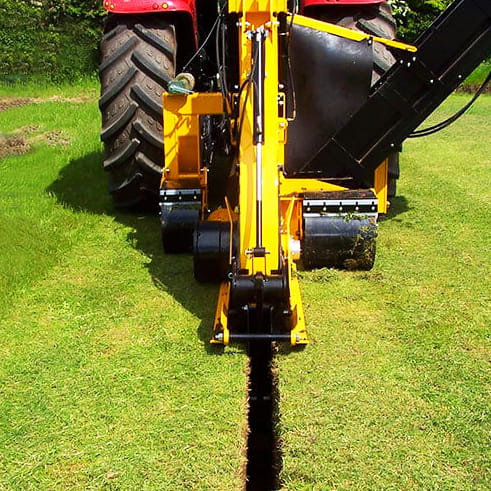


- TRENCHING
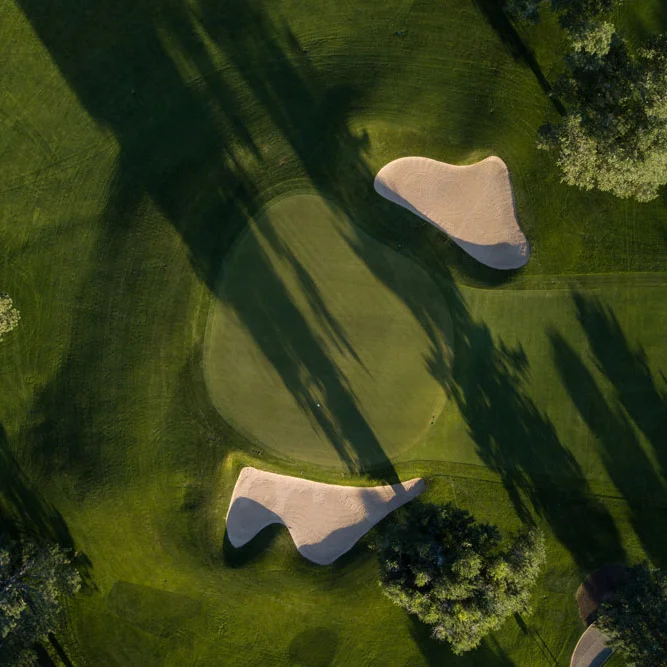
- Effective drainage of fairways, along cart paths, and bunkers are usually best achieved with a vertical Multi-Flow installation.
- Vertical installations provide a sizable intercept area but leave only a narrow scar in the turf. A 4 inch wide trench is optimal.
- Depth will be determined by factors such as:
- Anticipated depth of maintenance practices
- Desired depth of desaturation
- Width of area to be drained
- Required response time
- Speed at which full drainage is desired
- Subsurface physical features the location of irrigation lines.
- Effective drainage of fairways, along cart paths, and bunkers are usually best achieved with a vertical Multi-Flow installation.
- Line Length and Spacing
- On sloped surfaces a wider spacing is acceptable because gravity will aid in bringing water to the drain line.
- In fairways, a central collector line running up the center with arms reaching out into low-lying areas on either side, is frequently the best course of action.
- Product Size Selection
- A line of 6-inch Multi-Flow could reach capacity in about 150 feet of water collection.
- 12-inch Multi-Flow could drain up to 235 feet of length before it reaches capacity.
- 18-inch Multi-Flow could extend up to 360 feet.
- These lengths are based on the assumption that the line is collecting water from a 12 foot wide area during a one inch in one hour rainfall event.
- A line of 6-inch Multi-Flow could reach capacity in about 150 feet of water collection.
- Transport system
- After water has been collected by the Multi-Flow system, it must be transferred to a transport system for its journey from the site. This maximizes the total output of the system in a given amount of time.
The transport lines need to have a carrying capacity at least equal to the sum of all of the collector lines they are called on to service.
- For planning purposes it is useful to assume these numbers:
- Multi-Flow collectors:
- 6-inch ………………17 gpm
- 12-inch…………….. 29 gpm
- 18-inch…………….. 45 gpm PVC transport pipe
- 3-inch………………. ..52 gpm
- 4-inch……………… 112 gpm
- 6-inch……………… 327 gpm
- 8-inch………………..704 gpm
- If there is any danger that the water level at the discharge point will rise higher than the level of the collection system, a check valve should be installed on the discharge pipe. This will prevent contaminated water from backing up into the collector lines and causing siltation.
- An example will illustrate the consequences of line spacings. Assume 40 lines of 6-inch Multi-Flow in an area 210 feet by 400 feet (10 foot spacings). This will provide capacity to handle a maximum of 1.56 inches an hour, assuming:
- 17 gpm x 40 lines = 680 gallons per minute each side of the field.
- 680 gpm x 2 sides = 1,360 gallons per minute.
- 1360 gpm x 60 minutes = 81,600 gallons per hour.
- 210 feet by 400 feet = 84,000 ft2
- 81,600 gph / 84,000 sq./ft. = .971 gallons per sq./ft. per hr.
- .971 gal./sq. ft./hr. = 1.56 inches of rainfall per hour (.971/.623)
- Capacity could be increased by adding more Multi-Flow drainage line
- Three factors will determine the line spacing decision:
- Anticipated Schedule
- Local Rainfall Events
- Project Budge
- Equipment Needed
- 4-inch chain trencher and trenching spade
- Turf utility vehicle
- Utility knife
- Laser level
- Centering device(s) (optional)
- Water and/or vibratory packer (optional)
- Materials Needed
- Appropriate size of Multi-Flow pipe for collector system
- Appropriate Multi-Flow connectors
- Clean, very coarse sand
- PVC or ABS pipe for transport system
- PVC or ABS adaptors if needed
- PVC tape
- Appropriate Multi-Flow connectors
- Appropriate size of Multi-Flow pipe for collector system
- Trenching
- Plot a path through the problem area to a desired discharge point marking the path with paint or flags. Begin trenching at the discharge point and proceed toward the highest point of the problem area. Measure regularly to ensure that you are maintaining a proper grade. A laser level or transit is a useful tool in this situation.
- If the excavated material contains clay, remove it from the site before installing the drain.
- Laying Out the Drain
- Laying Out the Drain
- Roll out the drain beside the trench. At the ends, pull back the geotextile filter and snap the connectors in place. Connectors slip on more easily if they are manually pre-stretched. Push the fittings, such as end caps, couplers, side outlets or end outlets, firmly over the pipe to ensure a secure fit.
- Then pull the fabric over the fitting and hold it in place with PVC pipe tape. This ensures that soil will not enter behind the fabric and block the drain core during placement.
- Do not place Multi-Flow into a trench that contains standing water.
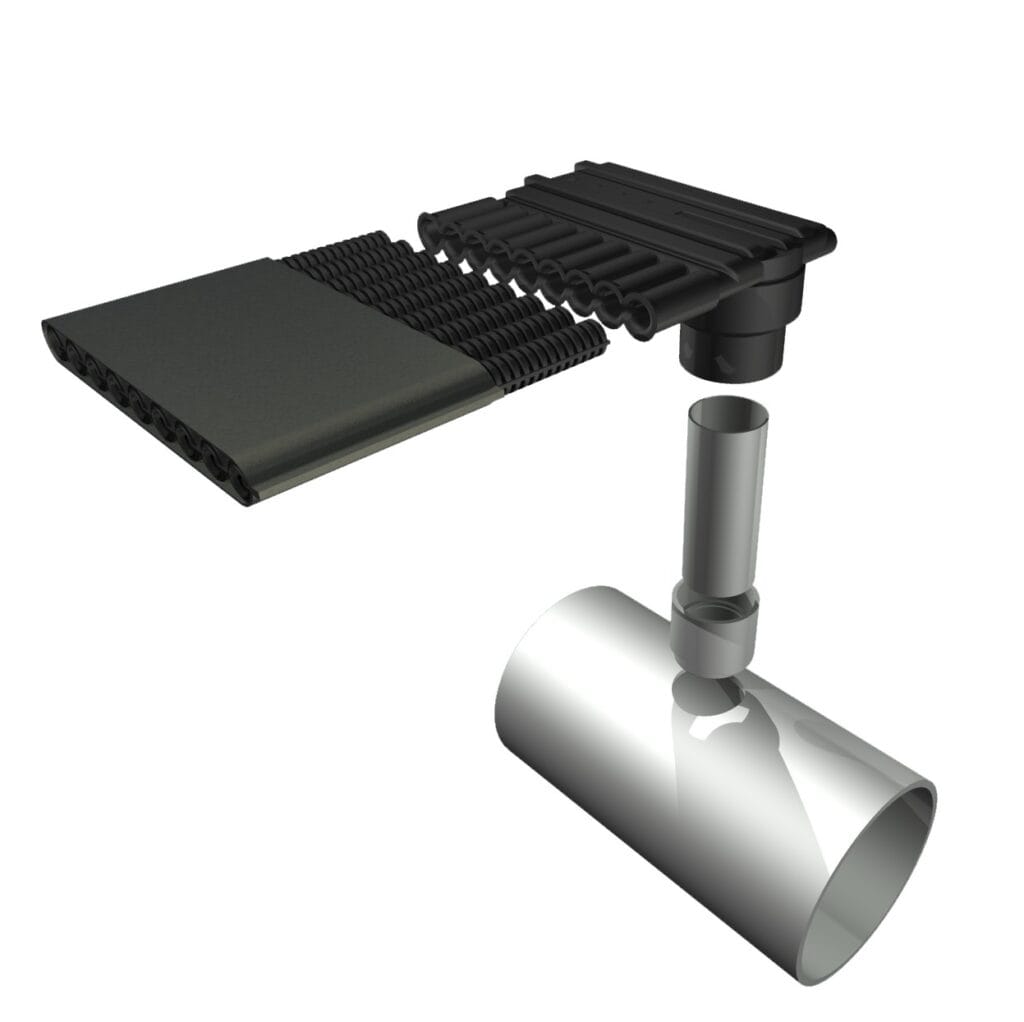
Usually connection to the transport system will be made with a multi-purpose connector. Most commonly this will be a 0600M, 1200M, or 1800M. These connectors empty from the bottom. Smooth, solid, rigid pipe makes for the most reliable transport system. Use of pipe cement will ensure a lasting connection. Multi-purpose connectors join to 3-inch PVC elbows and tees.
Insert the exit pipe and seal the joint using PVC pipe tape to prevent soil intrusion. Multi-Flow connectors attach to a 3-inch PVC.
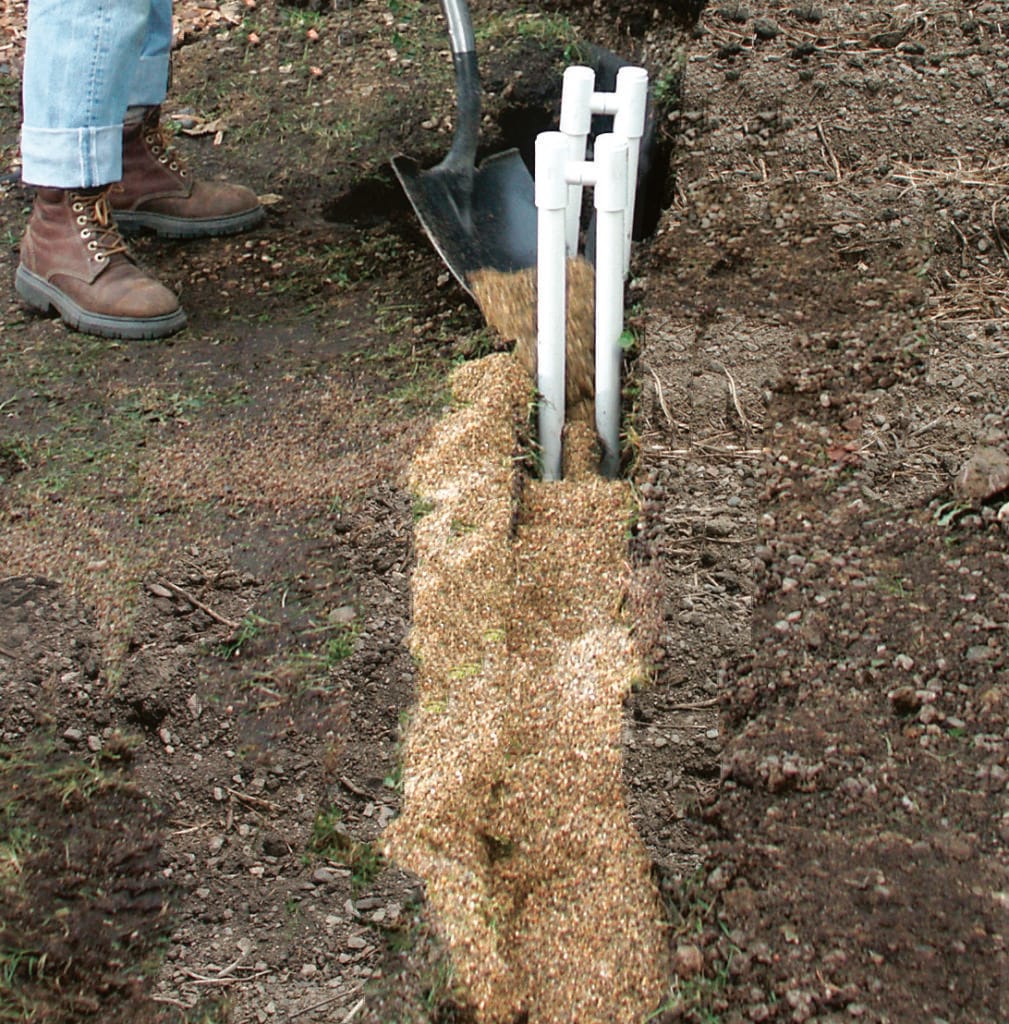
Use clean very coarse sand to fill the trench. Hold Multi-Flow in the relative center of the trench while backfilling. Centering devices are helpful in this task. Bring the sand up to the surface or near to it. Jetting the sand-filled trench with water will help to settle the sand in place more quickly. A small vibratory packer also works well.
Topsoil can be blended with the sand at the surface of the trench to create a better turf growing medium. Never, however, cap the trench with clay or other dense impermeable material. For more information on this topic see Selecting Backfill Material.
Horizontal Installation
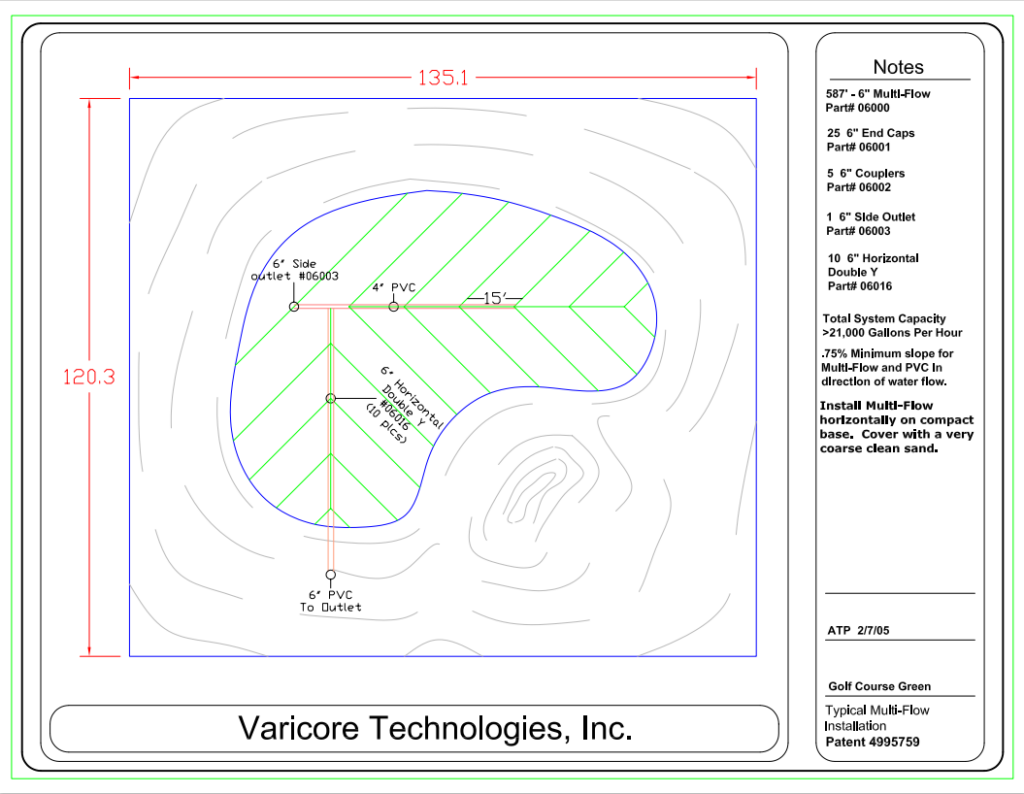
Collector lines can be positioned horizontally directly on the compacted base, or on top of the geotextile soil separator if one is used. No costly and time consuming trenching is necessary.
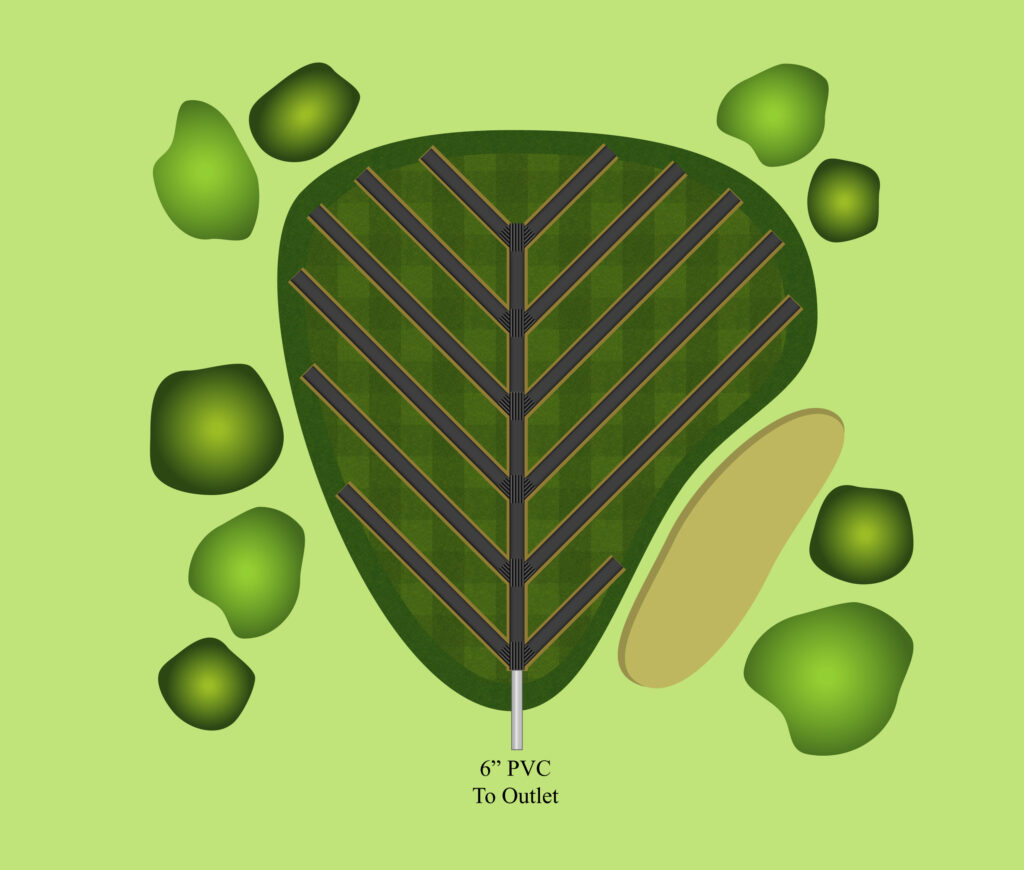
- Collector lines should be placed such that they intersect the water flow direction.
- Placing the lines at a 90 degree angle to the flow direction and running them toward the end zone is not the best policy because the resulting lines would be too long.
- A 45 degree angle running toward the sidelines works well because it allows the lines to maintain grade while also intercepting the direction of surface water flow.
- The resulting herringbone pattern complements the existing contour providing effective drainage as well as uncomplicated installation.
- This drainage pattern should extend all the way to the edges.
- Transport lines should be located around the edges.

The coarse sand and rock used in the horizontal instillation is capable of absorbing substantial amounts of water. Consequently, it is acceptable to allow more time for desaturating and as a result, collectors can be spaced farther apart. Placing collector lines 15 feet apart, outlet to outlet, provides excellent reaction time and uniform drainage performance. Twenty feet apart provides an adequate system. Employing 25 foot spacings will require significantly longer to drain after a rainfall event. It would be unwise to space them farther apart because allowing water to set on the compacted base for prolonged periods of time will soften the subgrade and destabilize the base.
An example will illustrate the consequences of line spacings. Assume twenty-seven lines of 6-inch Multi-Flow in an area 210 feet by 400 feet (15 foot spacings). This will provide the capacity to handle a maximum of 1.05 inches an hour, assuming:
- One 6-inch Multi Flow can carry 17 gallons per minute.
- 17 gpm x 27 lines = 459 gallons per minute each side of the field.
- 459 gpm x 2 sides = 918 gallons per minute.
- 918 gpm x 60 minutes = 55,080 gallons per hour.
- 210 feet by 400 feet = 84,000 ft 2
- 55,080 gph / 84,000 sq./ft. = .656 gallons per sq./ft. per hr.
- 656 gal./sq. ft./hr. = 1.05 inches of rainfall per hour (.656/.623)
System capacity can be increased by adding more Multi-Flow drainage lines.
Five factors will contribute to the spacing decision:
- anticipated intensity of field use
- local rainfall events
- project budget
- stability of the subgrade
- particle size of the select aggregate base
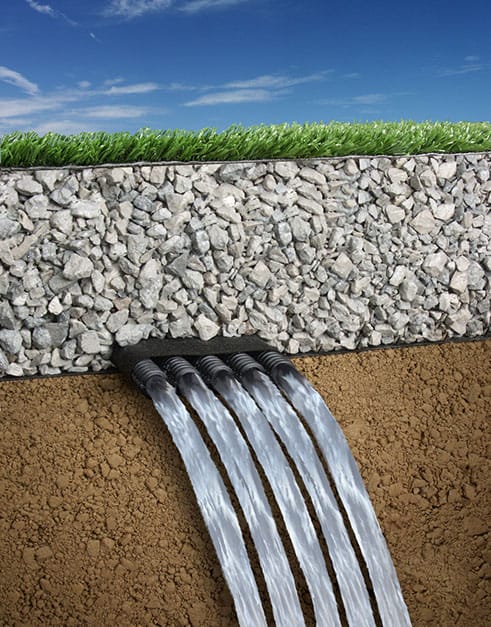
Due to strength and flow rate requirements, a smooth wall pipe makes for the best transport system. PVC pipe is commonly used. A standard PVC elbow or tee can be slipped over a Multi-Flow connector.
To design a transport system it is necessary to calculate the total drainage system capacity. For an example, let’s again assume forty lines of 6-inch Multi-Flow in an area 210 feet by 400 feet. If the area is crowned and laid out in a herringbone pattern, these lines will empty into the transport system on both sides of the area. So effectively, there are eighty collector lines. If each carried 17 gallons per minute, these eighty lines could deliver 1,360 gallons a minute or 81,600 gallons an hour. Sideline drains could increase that amount. Leaving the site, this would require a minimum of one 12-inch or two 8-inch PVC pipes.
If an 18-inch Multi-Flow is used as a collector line along the two side lines, and the 6-inch collectors empty into these 18-inch lines (using 1800P or 1800Q connectors), then it will be necessary to tap into the 18-inch line at calculated intervals in order to accommodate the volume of water. To calculate that interval, assume the following:
- 6-inch Multi-Flow = 17 gallons per minute.
- 18-inch Multi-Flow = 47 gallons per minute.
- 1800P or 1800Q = 112 gallons per minute.
- 4-inch PVC = 112 gallons per minute
Based on the above assumptions the 18-inch line should be emptied into the transport system once for every six or seven lines of 6-inch Multi-Flow. This is accomplished by attaching an elbow or a tee to the bottom of every sixth or seventh 1800P or 1800Q. The 18-inch perimeter drain is installed without a slope so the outlet to the transport line will be accepting water from both directions. Keep in mind that when the system is at full capacity there will be substantial head pressure on the system which will increase the flow rates of all components.
It is common to step up the size of the transport pipes as they proceed down the field, thus avoiding the cost of unnecessary large PVC connectors. A 4-inch PVC can carry 112 gallons of water a minute (1% slope, no head pressure) so it would be adequate for handling water from the first six collector lines. A 6-inch PVC would be suitable for carrying the previously collected water plus the water from the next thirteen collector lines. An 8-inch PVC could do the job the rest of the way down the area.
Assuming the 210 X 400 foot area from the example, if the 18-inch collectors are employed, it will empty into the collector system from an 1800P at six to seven locations along the left side of the area and from an 1800Q at six to seven locations along the left side of the area. Without the 18-inch collectors, each of the forty collector lines would empty directly into the collector lines on both sides of the area,
Transport pipes can be located beneath the sideline drain or in a separate trench beyond the sideline drain. The second option is generally more efficient and cost effective
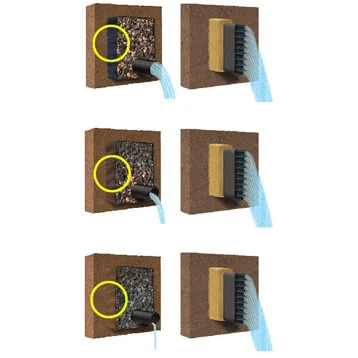
This sand backfill could be eliminated if the select aggregate is free from silt and clay, but this is seldom the case. See Selecting Backfill Material for more information on this topic.

Copyright 2025 | Varicore Technologies Inc. | All Rights Reserved.
Multi-Flow and Multi-Flow LDVS are property of Varicore Technologies, Inc.
The information contained on this site, including technical drawings, illustrations, pictures, diagrams, etc., are for recommendation only.
It is sole responsibility of determine correct suitability and usage of materials on project.